


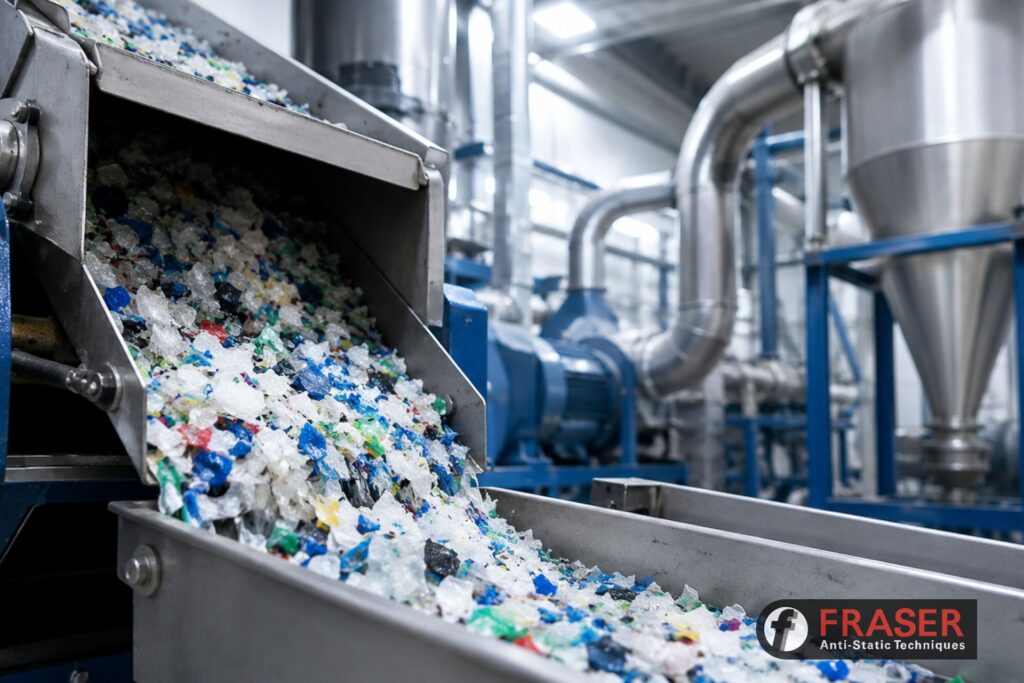
Static Electricity in Plastics Recycling: Causes & Solutions
Plastic recycling has become a critical part of modern manufacturing. As more companies incorporate recycled polymers into production, processors face new challenges in handling materials that often behave very differently from virgin plastics.
One of the most overlooked factors affecting recycling efficiency is static electricity.
Static charge develops naturally throughout recycling processes and can create problems ranging from material build-up and contamination to inaccurate sensing and unnecessary production stoppages. Understanding how static is generated and how it can be controlled is essential for maintaining reliable, efficient recycling operations.
Why Static Electricity is a Bigger Challenge with Recycled Plastics
Every stage of a recycling process has the potential to generate electrostatic charge.
Common operations include:
· Grinding and shredding
· Pneumatic conveying
· Washing and drying
· Separation
· Pelletising
· Storage and packaging
As the plastic materials interact with machinery, pipework and other particles, electrons are transferred between surfaces. This can leave materials carrying significant levels of electrostatic charge.
Unlike virgin material, recycled plastics often contain:
· Mixed polymer types
· Variable moisture content
· Dust and fines
· Irregular particle sizes
· Contaminants from previous processing
These variations can make electrostatic behaviour much less predictable and significantly increase process instability.
Typical Static Problems in Recycling Plants
Material Cling Inside Conveying Systems
Charged flakes, pellets and regrind frequently adhere to pipe walls, bends, cyclones and collection hoppers.
This can lead to:
· Reduced conveying efficiency
· Material build-up
· Blockages
· Increased cleaning requirements
· Interrupted production
In high-throughput systems, even relatively small deposits can gradually reduce process efficiency.
Inconsistent Material Flow
Static attraction can cause lightweight materials to separate unpredictably or bridge inside hoppers and feeders.
The result may include:
· Poor dosing accuracy
· Variable feed rates
· Inconsistent mixing ratios
· Reduced production rates
Maintaining consistent material flow becomes increasingly difficult as static levels rise.
Dust Attraction and Product Contamination
Plastic dust is readily attracted to charged surfaces.
Dust accumulation can affect:
· Pellet quality
· Optical sorting systems
· Finished product cleanliness
· Machine components
· Sensor readings
For manufacturers producing high-quality recycled compounds, contamination control is increasingly important.
False Signals from Metal Detection Systems
High electrostatic charge on plastic granules can interfere with metal detection processes.
This can generate:
· False reject signals
· Unnecessary production stops
· Additional inspection time
· Reduced production
Reducing static charge before detection improves system reliability.
Why Measuring Static Matters
Before selecting any static control solution, it is important to understand where and when charge is being created.
Static levels often vary depending on:
· Material type
· Flowrate
· Humidity
· Process speed
· Equipment configuration
Measuring electrostatic charge allows engineers to identify the root cause rather than simply treating the symptoms. A measurement-led approach makes it easier to position equipment correctly and verify that static control measures are delivering the intended results. This reflects Fraser’s application-led approach of understanding the process before recommending a solution.
Static Control in Pneumatic Conveying Systems
One area where effective static control can deliver immediate operational benefits is pneumatic conveying. During high-speed transport, pellets and recycled flakes continuously contact pipe walls, generating significant electrostatic charge.
Typical engineering challenges include:
Material sticking to pipework
Static causes material to cling to bends, elbows and collection vessels, increasing maintenance and reducing conveying efficiency.
Poor flow through conveying lines
Charged material can separate or accumulate at critical points, affecting throughput and consistency.
False metal detector alarms
Static charge on conveyed granulate can trigger unnecessary detector activations before bagging or downstream processing.
We suggest using the 3024 24V DC Ring Ioniser for reducing charge at key infeed points and before metal detection systems.
Correct positioning and application are essential to achieve the best results.
Process First, Equipment Second
Static control is rarely solved simply by installing an ionising device. Successful applications depend on understanding:
· Where static is generated
· How the material behaves
· Available installation space
· Operating distances
· Line speed
· Air movement
· Maintenance access
Even well-specified equipment can underperform if it is positioned incorrectly. In many cases, relatively small installation changes can significantly improve performance. Fraser’s engineering team works with manufacturers to understand the process before recommending the most appropriate solution.
Supporting More Reliable Recycling Operations
As recycling facilities continue to increase throughput and improve material quality, electrostatic control becomes an increasingly important part of overall process optimisation.
Reducing static electricity can help manufacturers:
· Improve material flow
· Reduce blockages
· Minimise contamination
· Improve final product quality
· Reduce unnecessary downtime
· Increase process reliability
Rather than treating static as an unavoidable side effect of plastics processing, understanding and controlling electrostatic charge allows engineers to create more stable, predictable and efficient recycling operations.
Speak to Fraser About Your Recycling Application
If static electricity is affecting your recycling process, our technical team can help assess your application and advise on the most appropriate approach.
Last Updated: 22 July, 2026