


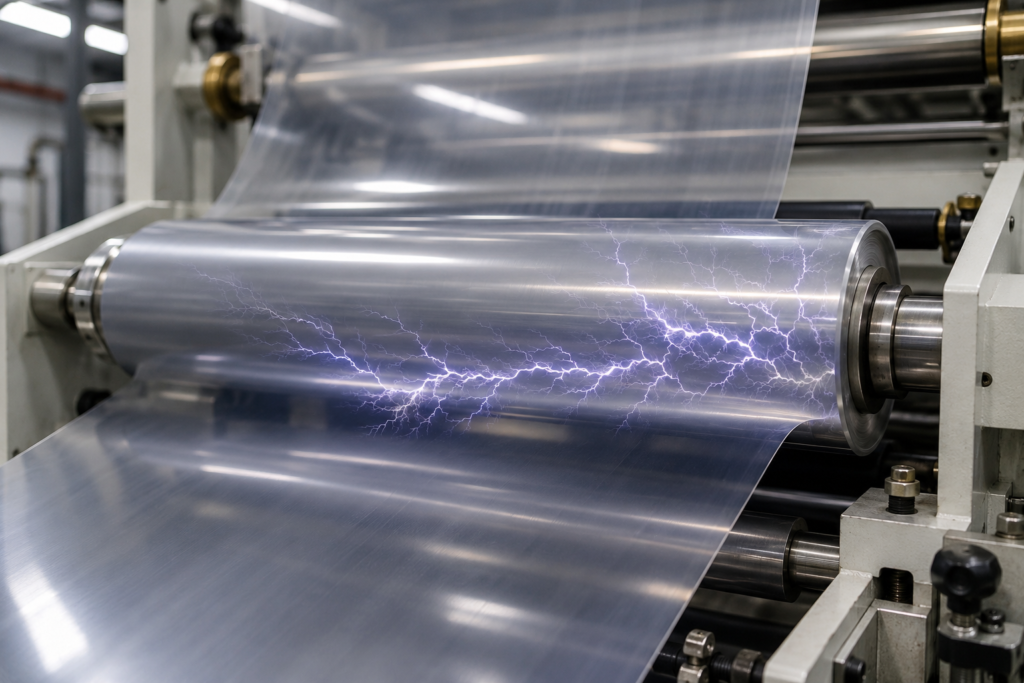
Five Static Problems Every Plastics Processor Encounters
Across extrusion, injection moulding, thermoforming, blow moulding and film converting, the same static-related issues appear time and again. The five problems below are among the most frequently encountered by plastics processors.
Static electricity is one of the most common and often underestimated causes of production issues in plastics processing.
Whether you manufacture film, sheet, moulded components, labels or flexible packaging, electrostatic charge is generated whenever plastic materials move, separate or rub against other surfaces. The result can be contamination, material handling problems, operator shocks, production downtime, unnecessary waste and even fires.
Fortunately, these problems are usually predictable and can be managed with the correct engineering approach.
This guide explains five of the most common static problems encountered by plastics processors and outlines practical ways to reduce their impact.
Why Does Static Electricity Build Up During Plastics Processing?
Plastics are excellent electrical insulators. As materials pass through extrusion, conveying, winding, slitting, cutting and packaging operations, contact and separation generate electrostatic charges.
Unlike conductive materials, plastics cannot easily dissipate these charges, allowing them to accumulate throughout the production process.
The severity of the problem depends on several factors, including:
· Material type
· Line speed
· Humidity
· Machine design
· Distance between materials
· Air movement
· Process changes
Understanding where the charge is generated is the first step towards effective static control.
1. Dust Attraction and Product Contamination
The Problem
Charged plastic components naturally attract airborne dust, fibres and other contaminants.
Even microscopic contamination can affect:
· Cosmetic appearance
· Printing quality
· Surface finishing
· Coating performance
· Packaging quality
For manufacturers supplying automotive, medical, electronics or consumer products, contamination frequently leads to increased rejection rates and additional cleaning operations.
Typical Symptoms
· Dust sticking to moulded plastic parts
· Contamination before printing
· Dirty film surfaces
· Increased quality inspections
· Higher scrap rates
Engineering Consideration
Removing static before the product reaches the next manufacturing stage can significantly reduce contamination and improve production consistency. Alternatively ionised air flows may be required to remove contamination from the product.
2. Plastic Film Sticking Together
The Problem
One of the most common questions engineers ask is:
“Why do my plastic films stick together during production?”
Static charge causes adjacent layers of film to attract each other, making handling increasingly difficult.
Processors often experience:
· Film wrapping around rollers and machine surfaces.
· Sheets sticking together
· Poor finished reel quality.
· Mis-feeds
· Difficult unwinding
These issues become more pronounced as production speeds increase.
Engineering Consideration
The effectiveness of static elimination depends not only on selecting suitable equipment but also on positioning it correctly. Distance from the material, line speed and airflow all influence performance.
3. Static Problems After Process Changes
The Problem
Static control systems often perform well for years before problems suddenly return. This doesn’t necessarily indicate equipment failure, instead, the process itself may have changed.
Typical changes include:
· Changes to, or new polymer material or formula
· Different suppliers
· Increased production speeds
· Seasonal humidity variations
· Machine modifications
Each of these factors changes how electrostatic charge develops.
Engineering Consideration
Periodic reviews help ensure static control systems continue to match current operating conditions rather than those that existed when they were first installed.
4. Material Build-Up During Pneumatic Conveying
The Problem
Static electricity frequently affects pneumatic transport systems handling pellets, granules, powders and recycled materials.
Common issues include:
· Material sticking inside pipework
· Hopper blockages
· Poor material flow
· Separation of mixed materials
· False metal detector signals
These problems reduce throughput and increase maintenance requirements.
Engineering Consideration
Controlling static within conveying systems improves material flow and reduces downstream process interruptions.
5. Operator Shocks and Production Safety
The Problem
Static electricity affects more than product quality. Operators may experience electrostatic discharges when working around charged plastic materials, while some industrial processes require careful management of static because of the surrounding production environment.
Processes involving solvent-based coatings, gravure printing and laminating are examples where controlling electrostatic charge forms part of an effective engineering strategy.
Engineering Consideration
Before selecting a static control solution, measuring static levels provides valuable information about where charge is being generated and its severity.
So, How to Solve Static Problems in Plastics Processing?
No two plastics processing lines generate static in exactly the same way.
The most effective approach is to understand:
· Where static is generated
· When it becomes problematic
· How it affects production
· Which process conditions influence charge levels
Only then should a suitable static control solution be selected.
As Fraser’s engineers regularly observe, successful static control is built around the process, not simply around installing equipment.
Experiencing Static Problems on Your Production Line?
Every plastics process is different, and static electricity rarely has a single cause. Material type, line speed, machine layout and environmental conditions all influence how static is generated and how it should be controlled.
If you’re experiencing contamination, product handling issues, operator shocks or unexplained production defects, Fraser’s technical engineers can help identify the source of the problem and recommend the most appropriate static control approach for your application.
Whether you need to measure static levels, review an existing installation or specify a solution for a new production line, we’re happy to discuss your process.
Speak to our technical team on +44 (0)1398 331114 or contact us to discuss your application.
Last Updated: 10 August, 2026