


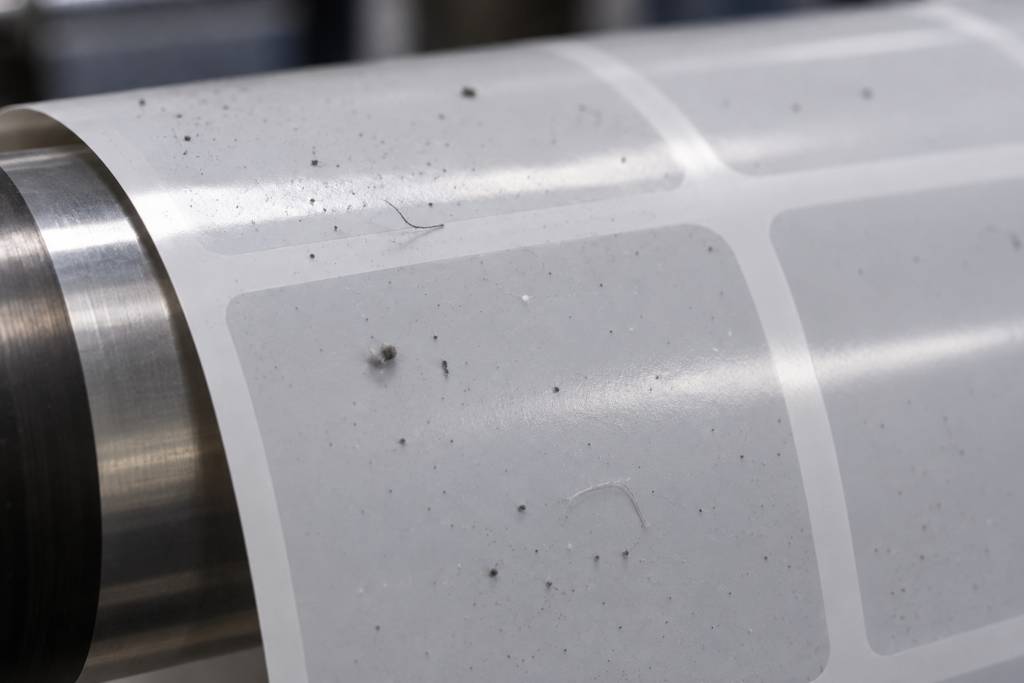
Static Electricity and Dust Attraction in Label Printing: The Root Cause Engineers Miss
Static electricity is the primary driver of dust attraction and airborne particle contamination in label printing and converting. When a substrate carries an electrostatic charge — even a few kilovolts — it acts as a particle magnet, pulling fibres, dust and debris onto the print surface before ink is applied. The result: visible defects, customer complaints, and avoidable waste.
Introduction
You’ve cleaned the press. You’ve checked the ink. You’ve adjusted the dryer settings. Yet the specks keep appearing on your labels, the ink feathering persists, and reject rates won’t budge. The actual culprit is invisible — and it’s been there the whole time.
Static electricity generates powerful electrostatic fields on plastic films, synthetic substrates and coated papers. Electrostatic charge on a surface causes it to attract particles from the surrounding air — and as long as the material remains charged, dust attraction continues. No air purifier or housekeeping routine can reliably overcome this, because the charge — not the dust — is the root cause.
At Fraser, we believe every manufacturer deserves to operate at its full potential. By controlling static electricity, we help create cleaner, safer, and more efficient production environments — reducing defects, contamination, and downtime while improving productivity and performance.
This article explains where static compromises print quality in label printing, why dust attraction is a symptom rather than the problem, and how engineers can identify and eliminate the true source of contamination.
Why Label Printing Is Especially Vulnerable to Static and Dust Attraction
Owing to the greater use of synthetic substrates, higher speeds and UV inks, label printing and converting is a growing market for static eliminators. Each of these factors structurally amplifies charge generation:
- Synthetic substrates (PET, PP, PE films) are electrical insulators — charge generated by unwinding, slitting or nip rollers cannot dissipate through the material
- High web speeds increase triboelectric charge generation at every contact point
- UV inks cure instantaneously — meaning any particle present at the moment of curing is permanently locked into the ink film
Static electricity attracts airborne dust, fibres, and particles directly onto the print surface; these contaminants become permanently cured into the ink, resulting in pinholes, bumps, and surface defects.
The physics is unambiguous: an electrically charged surface creates an electrostatic field that exerts a Coulomb attraction force on nearby neutral particles. The electric field from the static charge distorts the imaging process and causes shading on non-print areas when using UV inks — and removal of the protective film from a plastic sheet can generate a charge in excess of 50,000 V (50 kV), which can attract airborne dust from more than 1 metre away.
How Airborne Particles Reach the Substrate — and Why Cleaning Alone Fails
The critical engineering insight is the self-reinforcing nature of electrostatic contamination. Dust or other airborne particles cling to films, plastic parts or other charged surfaces, even in relatively clean environments — and removing the dust only shifts the problem, as contamination often reappears further downstream in the process.
The charges often prevent smooth transport, cause sheets to stick, attract particles to substrates, cause printing defects, reduce production efficiency, and lead to quality problems and customer dissatisfaction. According to research published on ResearchGate (2025), the financial impact resulting from static-related issues is estimated to reach millions of dollars for the industries.
In a typical label press, multiple charge-generating points exist along the web path:
- Unwind/rewind stations — film separation creates strong triboelectric charges
- Nip rollers and guide rollers — each contact point adds charge to the web
- Dryer and corona treatment units — both modify surface energy and can amplify residual charge
- The print station itself — particularly on flatbed digital presses printing onto rigid plastic sheets
Static electricity also attracts dust and other contaminants that settle on the printing surfaces and cause print quality defects; dust particles lead to specks, smudges, or other imperfections on the printed material, compromising its quality. This defect profile cannot be resolved by adjusting press parameters — only by eliminating the electrostatic charge that draws the particles in the first place.
Four Critical Static-Induced Failure Modes in Label and Converting Operations
Static-driven contamination manifests in four distinct and measurable failure modes:
1. Dust inclusions in UV and flexo inks
When substrates or films are electrically charged, they will attract particles of dust and lint — and a piece of lint on one substrate can cause a flaw in the final print. In UV flexo and UV inkjet label printing, this flaw is permanent once the lamp fires.
2. Ink misdirection and feathering
Static charge can cause ink droplets to repel or scatter instead of landing accurately, leading to fuzzy edges, colour inconsistency, and reduced sharpness. In pad printing applications on moulded label holders or 3D products, dust on the product before printing, ink-fly/feathering or cobweb patterning, and static build-up on the pad attracting contaminants are the three commonly encountered failure modes.
3. Sheet misfeeding and double-sheet pick-up
Static electricity makes sheets cling together during handling, resulting in feeding errors and interruptions in the printing process. In sheetfed label operations, this directly reduces throughput and increases waste.
4. Misregistration in multi-colour work
Misregistration is triggered by static charges affecting sheet positioning and alignment — causing registration issues, reprints, and reduced operational efficiency. For labels where colour-to-colour registration tolerances are tight, even minor electrostatic deflection at the feeder creates visible misprint.
The common thread: every one of these failures is a downstream effect of an upstream charge that was never neutralised. Static electricity is a common but often overlooked cause of production issues — from dust attraction and unstable material behaviour to shocks and quality defects, static-related problems can appear in many different forms.
Solving the Root Cause: Measure First, Then Neutralise
Effective static control in label printing requires a disciplined engineering approach: measure before you treat.
Fraser’s methodology — built on over 30 years of application expertise across plastics, packaging, and label converting, trusted by more than 10,000 customers in over 50 countries — follows this sequence:
- Measure electrostatic charge levels at each web contact point using a calibrated electrostatic field meter. On uncontrolled synthetic web lines, surface potentials of 20 kV to 60 kV are common. Fraser’s validated field data includes a documented reduction from 50 kV to 0.8 kV — a 98.4% reduction in static charge — achieved through correctly specified ionisation.
- Identify charge-generating zones — not all rollers contribute equally; measurement maps the true risk points.
- Deploy the appropriate ionising technology at each identified zone: static elimination bars (short range, high efficiency for web-close positioning), ionised air knives for blow-off applications, or long-range ionising bars where physical access to the web is restricted.
For label and converting applications specifically, Fraser’s ionised air range — combining static neutralisation with simultaneous dust removal — addresses both the charge and the particle contamination in a single pass. The 4125 Ionised Air Gun is not only an effective tool for dust removal but also neutralises the charge, preventing re-attraction of contaminants. Multiple formats (ionising nozzles, air knives, rotary cleaners) allow integration into existing compressed air pipework without line redesign.
Where solvent-based inks are involved — notably in gravure or flexo label printing with combustible inks — ATEX-certified ionisation is mandatory. Fraser’s ATEX range (certified to Directive 2014/34/EU and IECEx) includes the EX-715, one of the only ATEX-certified electrostatic meters available globally, enabling safe measurement in hazardous zones where uncertified equipment cannot legally be used.
FAQ — Static, Dust Attraction and Print Quality
Q: Why does my label press attract dust even in a clean environment? R: Cleanliness of the environment is secondary to the electrostatic charge level on the substrate. A charged film will attract particles from even a very low-particle-count atmosphere because electrostatic force exceeds gravity for fine particles. Without active charge neutralisation at the web, particle attraction continues regardless of housekeeping standards.
Q: How do I know whether static — and not ink or press settings — is causing my print defects? R: The diagnostic test is measurement. Use a calibrated electrostatic fieldmeter at the substrate surface immediately before the print station. Potentials above 2–3 kV on the web surface at print point are a reliable indicator that static is contributing to defects. If charge levels are elevated and defects are intermittent, correlated with humidity changes or substrate changes, static is the primary suspect.
Q: Can I solve dust attraction in label printing without stopping the line? R: Yes. Ionising air bars, nozzles, and air knives are designed to be integrated into running production lines, typically using existing compressed air supplies. Retrofitting an ionising nozzle into existing feeder pipework — as Fraser’s 4300 In-Line Nozzle is designed to do — requires no line stoppage and delivers immediate charge neutralisation.
Q: Is static control in solvent-ink label printing subject to specific regulations? R: Yes. Where solvent-based or combustible inks are in use, any electrical equipment — including ionising bars and meters — must comply with ATEX Directive 2014/34/EU (in the EU) and IECEx standards. Using non-ATEX-certified ionisers in such zones creates both a legal non-compliance and a genuine ignition risk.
Q: What is a realistic measurable outcome from static control on a label line? R: Fraser’s documented field results demonstrate charge reduction from 50 kV to 0.8 kV — a 98.4% reduction — using correctly specified ionisation. In label converting applications, this level of charge neutralisation directly eliminates the electrostatic attraction force responsible for dust inclusion defects.
Conclusion: Stop Managing Symptoms — Solve the Root Cause
Static electricity in label printing is not a nuisance — it is a precision engineering problem with a precision engineering solution. Every time dust appears on your substrate before the print station, every time ink feathers or misregisters, every time a film web behaves unpredictably, the charge level on that web is the variable that has not yet been controlled.
Fraser’s engineering-led approach — trusted by more than 10,000 customers in over 50 countries, backed by ISO 9001 quality management and approximately 10% of annual turnover invested in R&D — starts not with a product recommendation, but with a measurement. That measurement is what separates targeted static control from guesswork.
Ready to identify the root cause on your label line? Contact Fraser to discuss how we can integrate our static control solutions into your label or converting press configuration.
Last Updated: 6 October, 2026